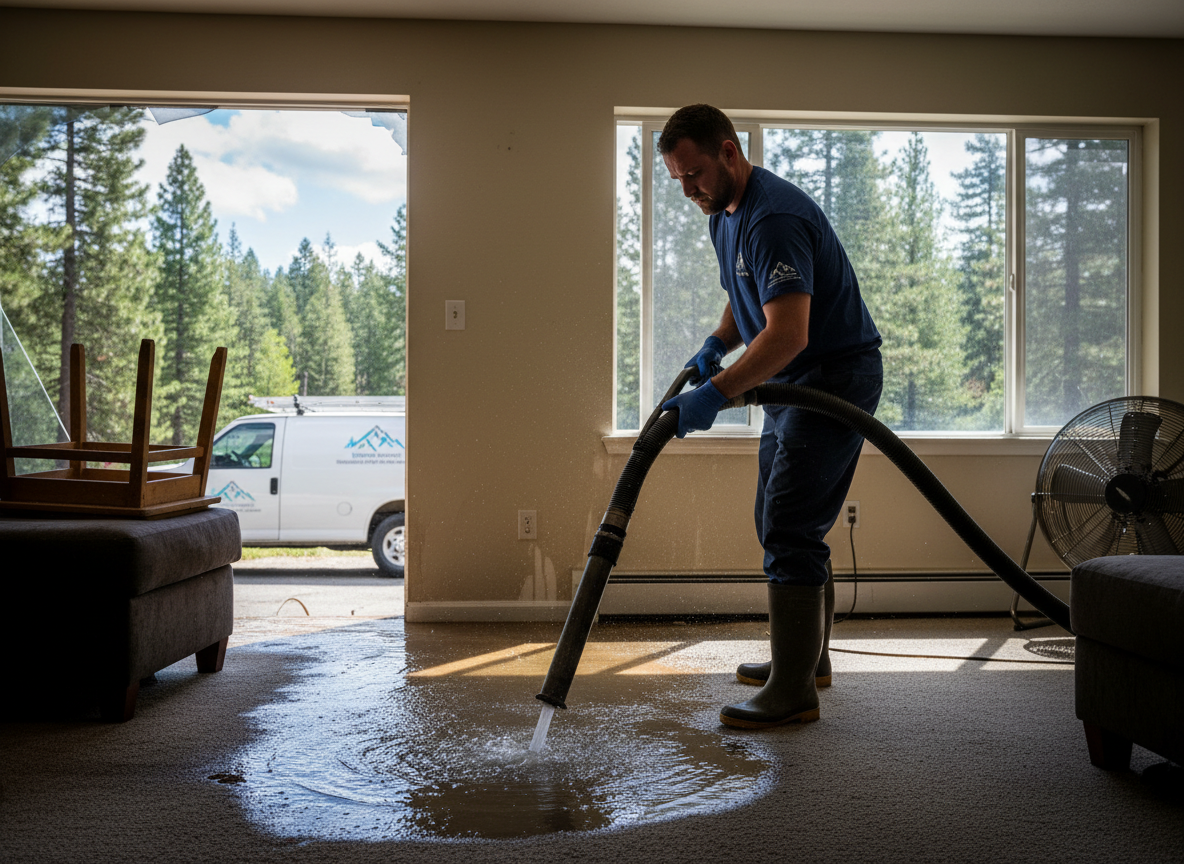
Cedarpines Park sits in the San Bernardino Mountains where cool winters bring snow that melts and refreezes, stressing older cabin-style homes with galvanized or polybutylene lines. Water extraction here often starts in crawl spaces and under pier-and-beam floors where meltwater pools against the soil and travels along the slope toward the foundation. Industrial extraction units must be carried in by hand because many driveways are steep and narrow, and any delay lets water wick into particleboard subfloors common in homes built before the 1990s.
Once standing water is removed, crews check for water that has migrated into wall cavities through the knotty-pine paneling typical of local construction. Hidden pockets behind baseboards or under kitchen cabinets in Crest Forest Drive homes can hold several gallons even after visible floors look dry. Technicians use moisture meters calibrated for the high-humidity microclimate created by surrounding pines to locate these pockets before they trigger mold growth during the next freeze-thaw cycle.
Access routes from Lake Arrowhead or Crestline can close quickly after heavy snow, so equipment staging at the 21853 Crest Forest Dr address allows faster deployment than waiting for trucks from the valley. Extraction hoses are kept short and pumps are gasoline-powered to avoid reliance on residential electrical service that often fails during winter storms. Every job ends with a written moisture map so homeowners can see exactly which rooms required extraction and why follow-up drying may still be needed.
Technician insight
In Cedarpines Park, the thing that catches most people out with water extraction is how fast snow melt travels under the raised floors of 1960s and 1970s cabins along Crest Forest Drive; homeowners often stop at the visible puddle and miss the water that has already wicked into the particleboard subfloor toward the downhill side of the lot.
Crawl-Space Extraction After January Thaw
A homeowner on a steep lot near Crest Forest Drive noticed water in the laundry room after several days of snow melt. Inspection showed the water had entered through a cracked ABS drain line and spread under the entire pier-and-beam floor toward the lower side of the property. Extraction units were carried in through the side yard, standing water was removed from the crawl space, and moisture readings were recorded on all joists before the crew left.
How it works
- 1
On-Site Assessment
Technician arrives, maps water migration through the home's crawl space and floor structure, and identifies affected materials.
- 2
Water Removal
Industrial pumps and extraction wands pull standing water from floors, carpets, and low-lying areas while protecting electrical systems.
- 3
Hidden Moisture Check
Moisture meters and infrared scans locate water that has traveled into walls or under cabinets common in mountain cabins.
- 4
Documentation and Hand-Off
Written moisture map and photos are provided so the homeowner knows exactly what was extracted and what drying steps remain.
Pricing
Pricing varies by volume of water, number of levels affected, and how difficult equipment access is on local mountain terrain.