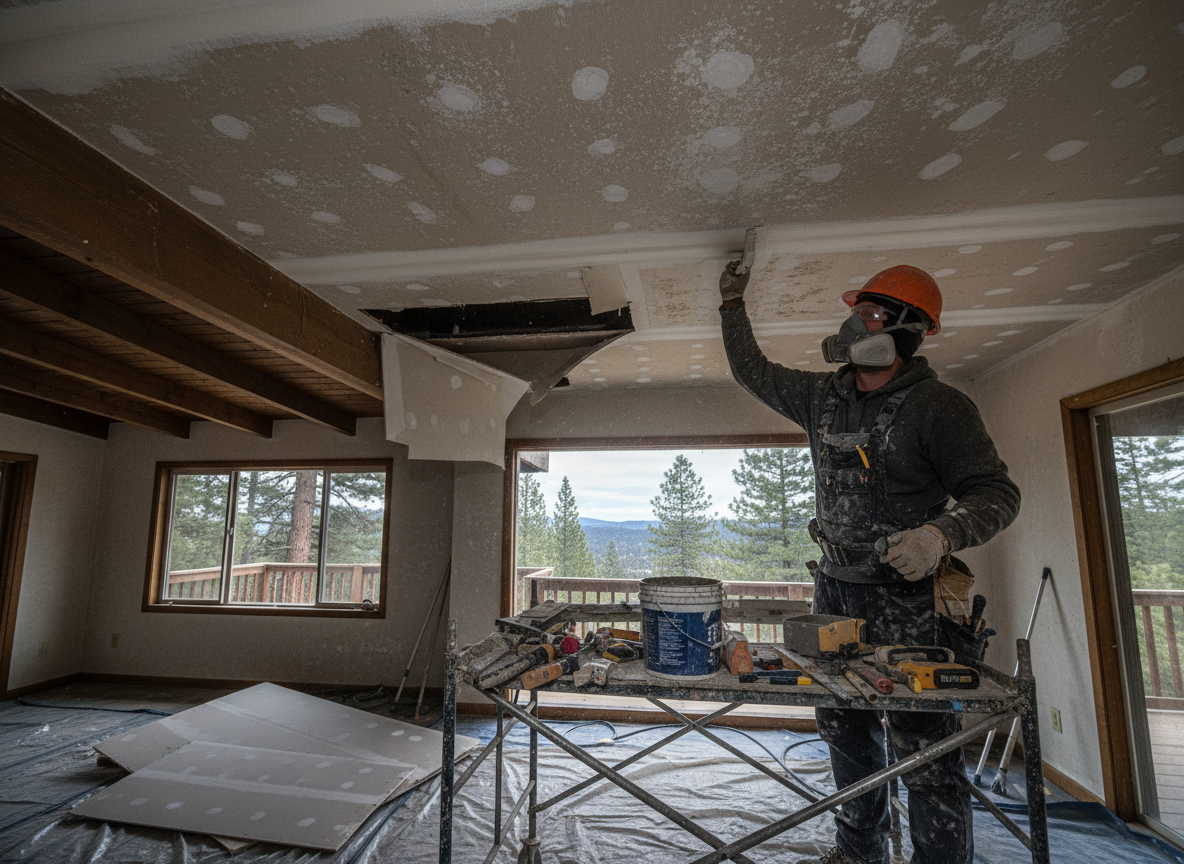
Cedarpines Park sits at elevation in the San Bernardino Mountains where heavy winter snow followed by rapid melt sends water under older roof flashings and into ceiling cavities. Homes here often date from the 1950s through 1970s with tongue-and-groove ceilings or layered drywall over original plaster, both of which trap moisture along joist bays. Once temperatures swing above freezing, that trapped water migrates laterally and stains finishes two or three rooms away from the entry point. Technicians must pull crown molding and lift sections of ceiling to reach the full wet zone rather than stopping at the visible stain.
Cool mountain air slows evaporation, so even small leaks can leave insulation and framing wet for weeks. We use moisture meters on both sides of the ceiling and behind adjacent walls, then place air movers and dehumidifiers sized for the volume of the attic space above. In many Cedarpines Park properties the attic is shallow and filled with blown-in cellulose that mats when wet, requiring complete removal before new insulation can be installed. Failing to clear the cellulose leads to recurring stains once the next snow load arrives.
Access on steep driveways off Crest Forest Drive or near the Lake Gregory basin often limits equipment size, so we stage drying equipment in smaller increments and monitor remotely. After drying we replace damaged drywall or plaster with moisture-resistant board where the ceiling meets exterior walls, then texture and paint to match the existing finish. Final checks include infrared scans to confirm no residual moisture remains in the joist cavities before the ceiling is closed.
Technician insight
In Cedarpines Park the thing that catches most people out with ceiling water damage repair is snow melt that travels along the underside of roof sheathing in pre-1980 homes and soaks cellulose insulation two joist bays away from the visible stain, especially on the steeper lots near Crest Forest Dr.
Winter leak above living room in Cedarpines Park
After a January thaw a homeowner noticed a brown line across the living-room ceiling. Inspection showed water had entered at a valley flashing, run along the roof deck, and soaked cellulose above two rooms. We removed the wet insulation, dried the joists, replaced the ceiling sections, and sealed the flashing edge before the next snow.
How it works
- 1
On-site assessment
We arrive 24/7, locate the water entry from roof or plumbing, and map the full extent of ceiling saturation using meters and infrared.
- 2
Containment and drying setup
Plastic barriers isolate the room while air movers and dehumidifiers pull moisture from cavities without spreading spores through the rest of the home.
- 3
Material removal and cleaning
Saturated insulation, drywall, or plaster sections are cut out; joists are treated and allowed to dry completely before any new materials are installed.
- 4
Repair and finish
New moisture-resistant drywall or plaster patches are hung, taped, textured, and painted to blend with the existing ceiling.
Pricing
Pricing varies with the square footage of affected ceiling, depth of insulation removal, and whether multiple rooms require drying.